
Sound Designer
Tower Defense Game (Unreal Engine):

SFX Recording & Editing
Stevens & Raybould (2016, p.59) state that any repetitive interactions with an object in the real world will produce a slightly different sound due to physical variables such as “the room temperature” or even “the loss of few atoms” within the materials as well as its reflection across the environment. Thus, Sikström (2008) explains that a great amount of variations for each sound effect would enhance the game’s realism and consequently the player’s immersion. Facing this task, I broke down the different sonic element of each sound effect to provide a greater amount of variations as well as a hyper-realistic feel. To illustrate, I divided the flamethrower shot sound into three main components: the fire, the flame and the blast. The cannon sound is a mix of audio samples such as cannon shot, explosion, distant explosion, metal debris and metal hits; the arbalest sound is a mix of whoosh, arrows, rope stretching and crossbow audio samples. Finally, the projectile hit sounds were created using a combination of vegetable impacts and impact samples .

Foley Recording & Editing
After designing the main game’s sounds such as the ambience and weapons I created the sound of the tower construction and gold. Audio samples and personal recording (using foley tools such as a rolling pin and cutlery) were mixed together to create the construction sound. Also, one specific sound was implemented into each cue depending which tower will be constructed. For example, I added a rope stretching sound effects when building an Arbalest tower, a metal debris sounds for the cannon tower and the sound of fire the flamethrower tower. I decided to add these particular sounds to add more variations to the construction cues. For the end of any tower construction, I recorded myself dropping a wide range of cutlery on the floor layered with audio samples. I made this choice because this sound easily cut through the other elements during busy gameplay sequences making it easier for the player to notice the complete action.

Sound Synthesis
The wind and falling rock sounds were created with the analog synthesiser 'Analog Key' by modulating white noise through an LFO (Low Frequency Oscillator).
Audio Implementation
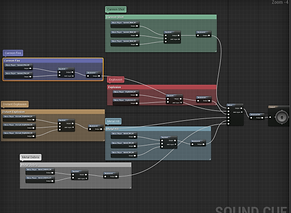
I processed each sound effect within Pro Tools on a dedicated auxiliary track to glue their dynamic and frequency response. Importing each individual element rather than a stereo audio file helped me to easily control my sound design mix. During the implementation process I used sound nodes such as modulator, randomiser and attenuation to enhance the game’s realism. I used modulator effects to improve my sound effects’ pitch variation and used attenuations effects for the most recurrent elements such as weapons, gold and vocal to avoid sonic chaos during busy gameplay sequences. I also created coloured comment boxes within each cues making my project more manageable.

Music composition
The music for this project was created in Ableton using my analogue synthesiser "Analog Key" and Komplete 10 from Native Instrument, especially the sampler Kontakt.
References:
- Sikstrom, E. (2008). Do variations make the sound design more realistic? Lulea University of Technology.
- Stevens, R. & Raybould, D. (2016). Game audio implementation: a practical guide using the unreal engine. Boca Raton: CRC Press, Taylor & Francis Group, CRC Press is an imprint of the Taylor & Francis Group, an informa Business.